Nóra Bükki Gálla
Generations of choreographers thought music was a painful limitation to their work, so they escaped it. How? Well, they invented many clever ways. Using experimental works were one good option, sound recordings hardly recognizable as music – and of course there is the absolutely honest and inscrutable solution of not using music at all (variations include spoken texts, breathing and other noises the performers make). If none of those things seem possible, you still have the option of simply ignoring the piece of music that is played during the performance. And that’s it – one thing nobody does today is dancing to music. Making a dance piece with the particular aim of illustrating music is so very unthinkable…
…that actually it’s worth a try.
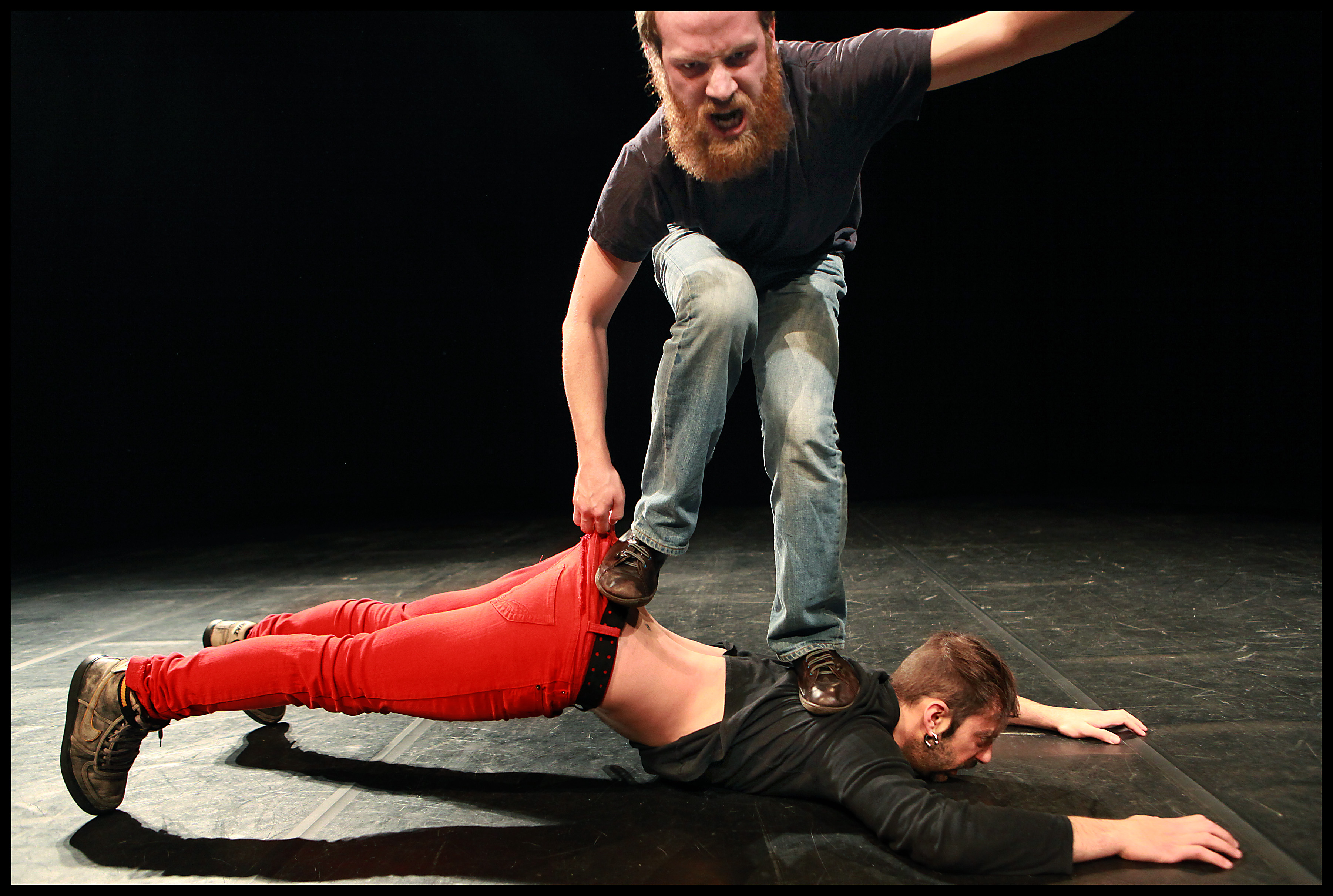
That is what French choreographer Maud Le Pladec must have considered when she decided to do a piece for the eerie and unsettling sound-mix of Fausto Romitelli, Professor Bad Trip. The composition is based on violin and electric guitar tunes, manipulated and amplified to the point of becoming a chaotic rumbling. The soundtrack itself consists of three parts; this structure is reflected in the choreography, offering multiple layers of meaning. We keep bumping into the iconic number three: there are three lectures of the’ Professor’, each lecture being announced by a narrator’s voice; there are three black-clad figures, very similar as the music suggests, still not identical. We also have three types of activity that these figures are engaged in: dance, mime-like everyday gestures and the actual making of live music (one of them is playing an electric guitar backstage, producing soundwaves instead of tunes). The stage is divided into two by an important third element: a black curtain revealing and hiding the dancers as their movement is conducted by the absolute dominance of music.
The first lecture is about pure dance: a solitary figure acts out the sounds and notes of music. Movements are modulated and tuned in a way to not only reflect on, but actually and in a very literal way perform music, spell it out with motions that are connected to everyday gestures, but still are made abstract in order to match the music’s ambiguous quality. Movements are clever and articulated, even ironic and inventive in the sense the music is. Le Pladec does not aim to exceed the limits set by the soundtrack but manages to cover this specific audiovisual terrain with a playfulness of movement that enriches the piece.
The second lecture leads us toward a more theater-like experience: the curtain at the back of the stage opens up to reveal a second figure playing a guitar. A strange hide and seek scene enfolds in which all three dancers make their appearance – in their similarity they look like they are actually one person in three different bodies, making the game puzzling and entertaining at the same time. The third lecture is on acting: the three figures are engaged in different poses, using excessive gestures and facial expressions; they face the audience and play ping-pong with the sounds of the music or move the other one like he was a life-size puppet.
The scenes seem to lead to nowhere in particular but then the music does the same: it arches from quietly weird to disturbingly abstract without offering an easy reading. Professor is a strictly formalist piece leading in a witty line from dance to theatre, from the graspable to the abstract and from the two dimensions of music and dance to a third of multiple interpretations, still with the clear intention of being no more than what it is: an embodiment of the music that inspired it in the first place.


 iDANS Blog