Skip to content

Posts from the ‘Inceleme / Review’ Category

Nicole Beutler – Songs

Maxime Fleuriot

Nicole Beutler – Songs

Songs is a solo performance that takes the appearance of a concert led by Sanja Mitrovic. Wearing a very classical and simple dress (« bourgeois » style) the woman looks like rather shy. Yet the outrage and the strenght that show up in the voice, the craziness that show in the eyes and the whole face create an interesting contrast with her appearance. This combination is curious, unique and striking. So are her movements, always surprising, always unexpected. She literally hold the stage with great self confidence. One could think of Claudi Triozzi because of the experiments with the voice but Nicole Beutler’s performance is much darker in what it conveys : suffering, isolation. In fact, it doesn’t look like anything we could have seen before which is the sign of the great performers. However, if the performance starts very well, it loses its powerful charm as it goes on. Unlashing her hair, opening her dress, the performer becomes clearer in her intentions : expressing feminine despair and solitude. The discrepency betwen the appearance and the underlying outrage of the voice tend to disapear. The lyrics of the songs become clearer. Everything become too obvious and one way. Behind the performer, on a screen, since the beginning of the performance, old images are shown. Names of literary heroines appear on these pictures : Ophelia, Antigone, Medea… The images are nice but this will to inscribe this feminine presence in a more general litterary context remain at the level of an intention and seems a little bit forced.
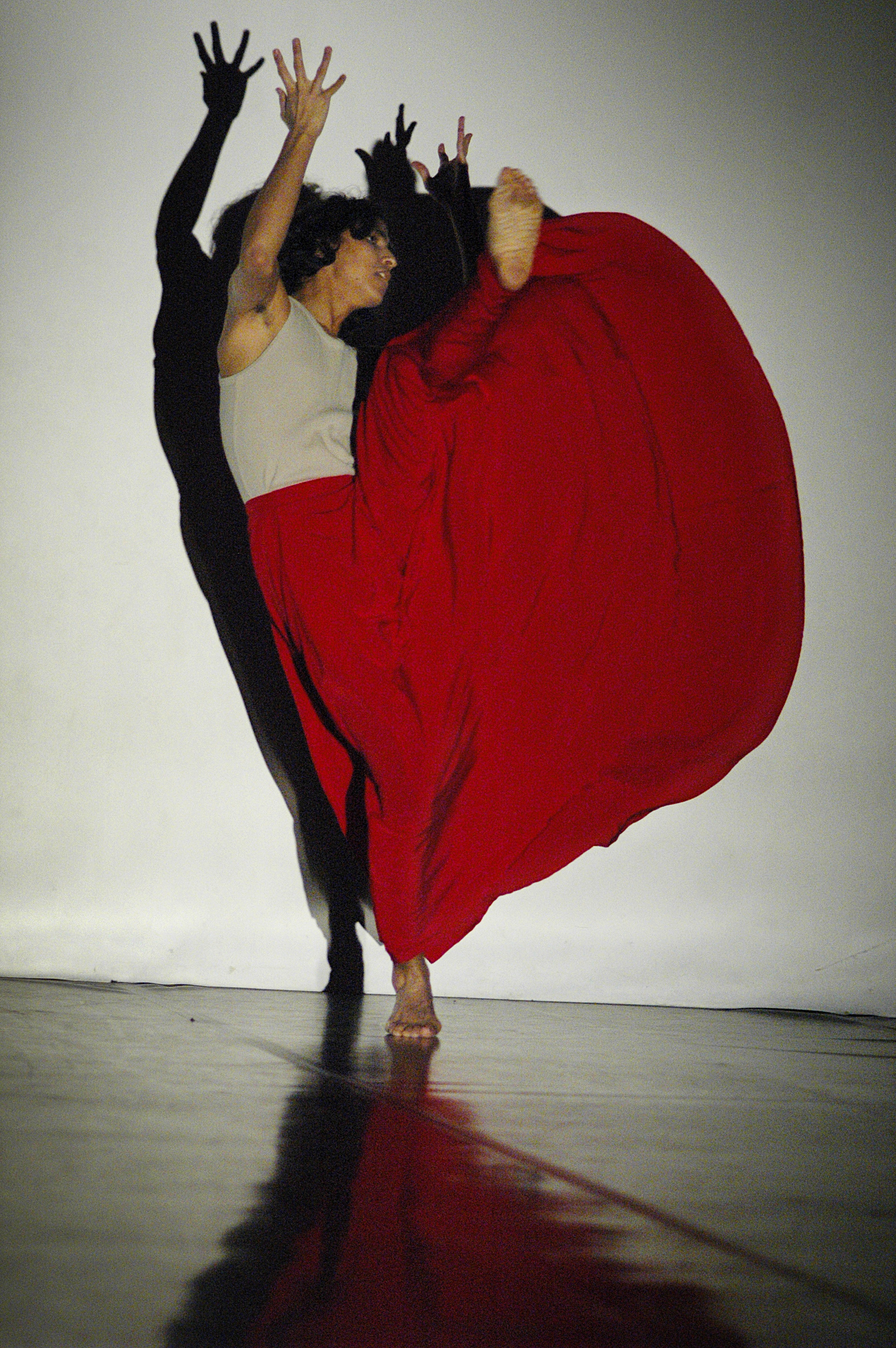
Fabian Barba – A Mary Wigman Dance Evening

Eylül Akıncı

Fabián Barba’s reconstructive work on Mary Wigman, A Mary Wigman Dance Evening, is based on the utmost reassembly of the theatrical elements Mary Wigman used as well as an intention to present her dance in the most faithful way possible, not without accepting that one-to-one staging is impossible and a carbon copy is not even a consideration.

It is not easy for me to asses the original and reconstructed parts of the solos –from three dance cycles, Seraphisches LiedPastoraleSommerlicher Tanz- separately, and probably for any viewer who had not gone through the footage and photo archives; in a way this implies the fact that Barba has succeeded to convey a devoted interpretation and to decipher the intrinsic qualities and aesthetics of Ausdruckstanz in terms of logic, emotion and expressive process. He smoothly constructs a whole work out of the fragmentary material from Wigman’s legacy.

The strange encounter between Barba and Ausdruckstanz, which he himself claims to have had, not necessarily might be valid for the audience, though. In this case, personal history of spectatorship indeed plays an important role; furthermore, certain codes of expressionism –especially German expressionism- is still with us in an internalized and unnoticed way thanks to a myriad of artworks from various disciplines, bearing its undertones on our current experience art and daily life to some extend. After all, changing subjectivities of expressionism is exactly what has not changed after the modernity, and it is not easy to define a big hiatus that would erode memory between modern and post-modern era although most of our presumptions about dance and movement has been transformed on that threshold as much as it had at the beginning of 20thcentury, for this evolutionary history is not an exhaustive one that would create amnesia and, of course, we still have active representatives of these first generation dance forms.

However, watching Barba’s reconstruction is definitely surprising, if not uncanny; sitting face to face with something like a part of your cultural subconscious is enlivening. Mary Wigman becomes alive, gender neutral, breathing loud, in whirling and entrancing costumes (successfully recreated by Sarah-Christine Reuleke), under the music of husky piano and drums, under the chandeliers and behind the red velvet curtain. It feels like a 3D simulation of a 30’s evening indeed, and it creates an excitement in spite of one’s possible familiarity with the expressionist dance by its daintiness on details. The performance as a whole frees the image and movement of Mary Wigman from monochrome and scratchy visuals, thus in a way becomes a live documentary, as much as it is a unique performance, that freshens up our relationship with the past.

Mary Wigman’s Coming Back

Iulia Popovici

Her real name was Marie Wiegmann. She was a dance goddess of the twentieth century. Dance histories of the period consider her the most important expressionist choreographer and put her on the same footstall next to Laban and Isadora Duncan. Mary Wigman is a legend – and, since no still living man witnessed her original performances, they also linger in the realm of legendary.

Nobody really knows what made Mary Wigman’s dance works so striking innovative and emotionally strong. We all trust the books we read, the poor quality black and white videos and, of course, the legend. Or not.

In A Mary Wigman Dance Evening, the young Ecuadorian dancer and choreographer Fabián Barba revisits the artist’s 1930 tour to the United States, re-enacting nine of her solos from three different series, “Celebration”, “Visions”, and “Swinging Landscape”, dated 1926, 1927 and 1929. He worked with every existing source: video recordings, still photographs, reports, reviews, biographical and critical material and Wigman’s own texts. He does it in the context of a dancer never actually interested in her personal posterity (unlike Laban, Wigman didn’t “produce” a technique) – and Barba’s archeological endeavor is more than remarkable. He tries to reproduce everything: from the hand program, the lighting, the intermission music, and the fabric of the costumes, to the actual attitude, movement, dancer’s gaze and muscular tense (including her elegant bows in front of the audience). He turns Mary Wigman’s 2D, black and white recordings into Mary Wigman in colors and 3D.

Or, again, not. Again and again, dance proves to be not about movement in general but about one particular body in movement. Some of Wigman’s solos (as those belonging to the “Visions” series) put into movement what she called the Gestalt, a genderless figure whose costume and dancing pattern make abstraction of the gender/ feminine particularities of the body on stage. It is a choreographic form that allows, inside its own original structure, the 26-year-old man to replace, in re-enacting, the 40-something-year-old woman performing almost a century ago. But in many other moments – the bows included – Fabián Barba’s body can only give a glimpse, or not even that, of what Mary Wigman moving body (more than the dances themselves) could have looked like. More than about postures, technique or cultural inheritance, A Mary Wigman Dance Evening seems to be talking about the uniqueness of the body in movement.

Visiting history has, as always, its ups and downs.

mary wigman fabian barba

Julie Rodeyns

The young Ecuadorian dancer and choreographer Fabian Barba is fascinated by the legendary German expressionist dancer Mary Wigman (1886- 1973). As he graduated from the prestigious dance school P.A.R.T.S. in Brussels, he already put one of her early solo’s to the stage. For his first evening length piece: ‘Mary Wigman, a dance evening’, he brings a re-enactment of nine short dances. Before the intermission, you see six solos from the cycle ‘Shifting Landscape’ (1929). After the break Barba brings fragments from the works ‘Visions’ (1925- 28) and ‘Celebration’ (1926).From the moment you walk in the theatre, every little detail tends at bringing you back to the first decades of the 20thcentury: fi. the two chandeliers hanging a bit clumsy over our heads and the programmes on every seat, that tell us what to expect once the heavy, red curtains open. That air of nostalgia never disappears, but as soon as Barba appears on stage, you’re immediately put back in the 21st century. Instead of the fierce Mary Wigman, it’s a young boy standing there, in a dress. Don’t expect a tranvestite show however.Barba brings the solos with a seriousness and concentrated dedication that is fascinating and very convincing. He relied on videos, photos and texts and talked with dancers who studied at the Wigman school to recreate these dances. Sometimes their tone is –like the accompanying music- tender and the mouvements soft and fluent, but never unprecise. Other dances have a stronger and more upfront character. Either way, the tempo is much slower then what we usually see on stages today, which allows every single mouvement to be clearly demarcated. Off course the discussion to what degree Barba’s reconstructions are an accurate reproduction of the original pieces (something that is off course never totally possible) is an interesting one. However, it’s this physical control and preciseness in incorporating these solo’s of Mary Wigman that keep ‘A Mary Wigman Dance Evening’ a fascinating performance, even after viewing it for the fourth time.

Fabian Barba – A Mary Wigman Dance Evening

Maxime Fleuriot

One of the particularities of dance is that we do not have direct access to the works of the earliest dancers. What do we know of Nijinsky’s dance for instance that revolutionized dance history ? Some photos, some testimonies and that’s all. As dance is developing, scholars and dancers feel the need to investigate their own history. One recalls the efforts of Quatuor Knust (Emmanuelle Huyhn, Boris Charmatz…) to recreate L’Après Midi d’un Faune de Nijinsky. Here, Fabian Barba, a young Ecuadorian dancer trained in PARTS, has chosen to recreate Mary Wigman solos, one of the pioneer of modern dance. Basing his work on pictures and videos of that period, on testimonies – among which the one of choreographer Susane Linke who used to be a student of Wigman – Fabian Barba has recreated as series of nine solos created by Wigman between 1925 and 1929. He has also paid attention to make the whole program seem like a 1930 theatre evening : curtains, chandeliers, the music that is played on an old gramophone evoke the 1930s. Even the programs have a 1930s look. This coherence in aesthetics is one of the major qualities of this work. The major interests one can find in Barba’s work is to grasp something of Mary Wigman’s dances. Where else do we have such opportunity ? This way of re-actualizing historical works, of making it present, vivid is fascinating for one who is used to photos and videos. This impression is increased by the attention paid by Barba to the costumes and quality of movement. One is not used to this graphic quality of movement, this length, these geometrical shapes, the suspension of an impulse on time to increase its dramatic tension. Actualized in a young body, this quality of movement seems absolutely peculiar and contemporary.

And maybe that’s more true that one could think first. The graphical, almost pictural quality of the dance reminded me some of Raimud Hoghe’s recent performances – the German choreographer (For instance this performance based on Maria Callas ‘s pictures36, avenue George Mandel). And the reference to an canonical figure of dance history pointed all the more the very personal dimension of the work of Barba. The way this Ecuadorian young dancer embodied a forty years woman living in the 1920s. Or also, the stress on bows which were performed at the end of every solo in a different style every time. This was a very contemporary way to stress the choreographic quality of something usually considered as non choreographic.

Bad Examples by Lise

Lise Smith
Bad review example 1:
http://www.londondance.com/reviews_details.asp?C=Bolshoi+Ballet&P=Le+Corsaire&V=Royal+Opera+House

Then, after I had selected the above example, this second bad review popped into my Twitter feed:
http://www.ft.com/cms/s/2/9bc24dc8-dacf-11df-a5bb-00144feabdc0.html

Good Example by Lise

Lise Smith
A review I liked:
http://www.guardian.co.uk/stage/2010/oct/03/russell-maliphant-company-theatre-review