Skip to content

Posts from the ‘Yazılar / Texts’ Category

Bread and Games

Dean Damjanovski

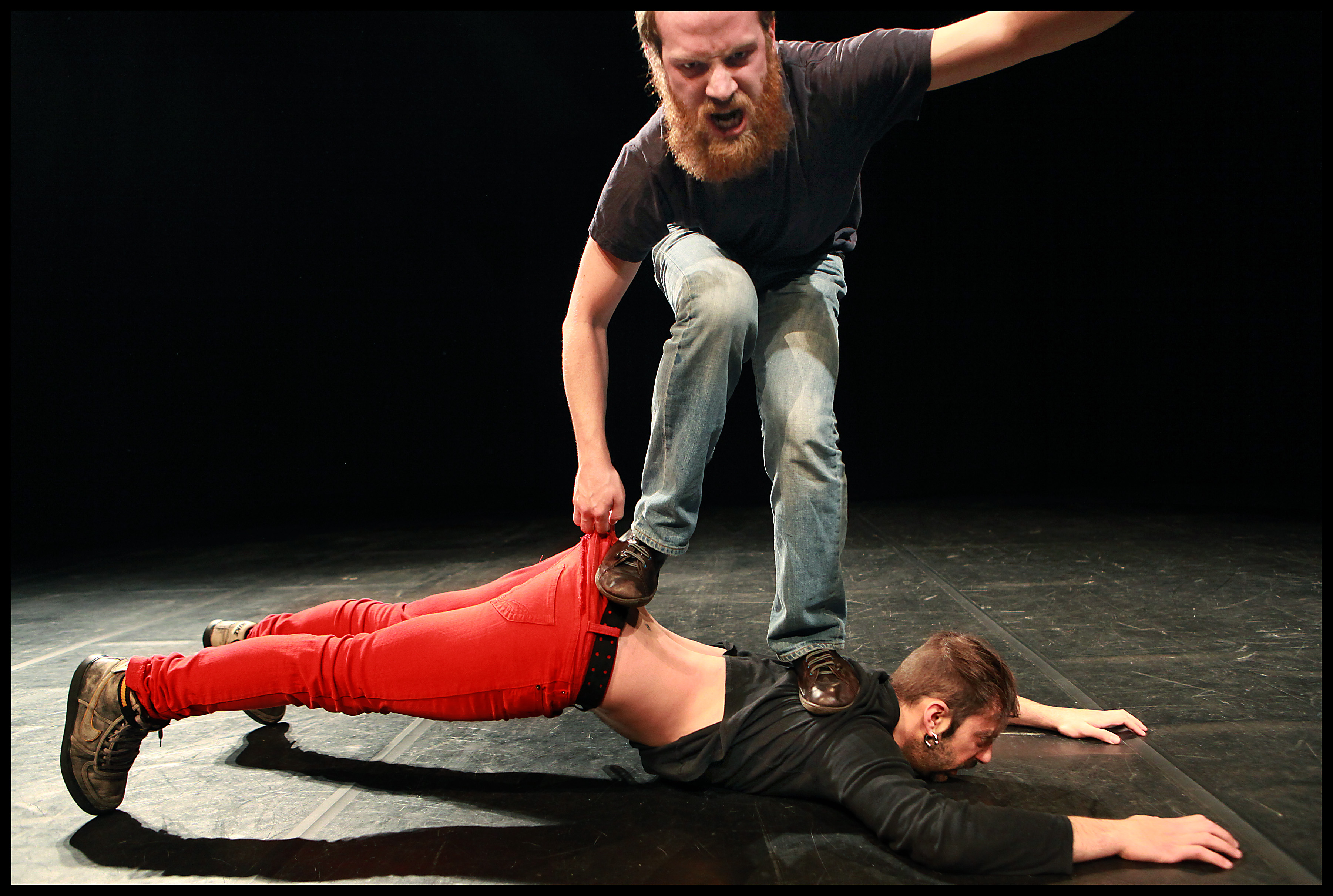
Violence and demonstration of masculine strength are inseparable part of entertainment. Since the time of the Roman gladiators and Japanese sumo-wrestlers till the American WWF the pleasure that the spectator gets from the clash of raw force on stage is a sensation that can not be compared to anything else. The protagonists Pieter Ampe and Guillherme Garrido in their “physical drama” titled Still Standing You offer themselves and their bodies for audience’s entertainment. Since the very beginning we see them on the full lit stage in a strange position – one of them lying on the floor with his feet straight up and the other sits on his soles. After establishing contact with the audience they say “Now we will perform our contemporary dance” as if they are saying “let the games begin”.

Read more

Much Better Than Sex

Nóra Bükki Gálla
I always wondered how secret agents in films gritted their teeth but still kept their mouth shut when they were tortured in various inventive ways. They say it’s training, a kind of technique they learn about how to endure suffering, both in a mental and a physical sense. Pieter Ampe and Guilherme Garrido in their provocative and courageous duet of pain management are actually turning it all into a game. A game in which we cannot just stand aside and be polite observers.

Read more

Still standing you, ampe and garrido

Julie Rodeyns

Still Standing You – Pieter Ampe & Guilherme Garrido (production: Campo)

In the duet “Still standing You”, the Flemish choreographer Pieter Ampe and his Portugese partner Guilherme Garrido constantly try to surpass each other. The result? A very entertaining farce that gives not only a portrait of a friendship but also raises questions about the strengths and limits of the physical body.

Read more

Pickable Limbs and Curly Pubic Hair

Two overgrown preteen boys hurling, stepping on, pulling around each other in a mock-fight; or two WWE members wrestling with exaggerated gestures and mimics of pain and victory… At first glance, Pieter Ampe and Guilherme Garrido’s Still Standing You reminds you of such scenes; at second you think that no surprises, you get used to this “chubbies’ violence show”. But instantly you begin to feel that the two dancers’ never ending effort to take each other down, ride on and drag around is totally unrelated to violence or games: it is a restless and compelling quest to find their place and position within/towards one another.

Read more

Please be advised that there is a warning on this one

Lise Smith

If the filmmaker David Lynch were ever to make a contemporary dance piece for three Gallic performers, it would probably look and sound something like Maud Le Pladec’s Professor. Looming shadows, dancers disappearing through the curtains, slow-motion visual effects and an aurally uncomfortable soundtrack – all it needs is a dancing dwarf, and the Lynchian setting would be complete.

Read more

Strings

Nóra Bükki Gálla

Generations of choreographers thought music was a painful limitation to their work, so they escaped it. How? Well, they invented many clever ways. Using experimental works were one good option, sound recordings hardly recognizable as music – and of course there is the absolutely honest and inscrutable solution of not using music at all (variations include spoken texts, breathing and other noises the performers make). If none of those things seem possible, you still have the option of simply ignoring the piece of music that is played during the performance. And that’s it – one thing nobody does today is dancing to music. Making a dance piece with the particular aim of illustrating music is so very unthinkable…

…that actually it’s worth a try.

That is what French choreographer Maud Le Pladec must have considered when she decided to do a piece for the eerie and unsettling sound-mix of Fausto Romitelli, Professor Bad Trip. The composition is based on violin and electric guitar tunes, manipulated and amplified to the point of becoming a chaotic rumbling. The soundtrack itself consists of three parts; this structure is reflected in the choreography, offering multiple layers of meaning. We keep bumping into the iconic number three: there are three lectures of the’ Professor’, each lecture being announced by a narrator’s voice; there are three black-clad figures, very similar as the music suggests, still not identical. We also have three types of activity that these figures are engaged in: dance, mime-like everyday gestures and the actual making of live music (one of them is playing an electric guitar backstage, producing soundwaves instead of tunes). The stage is divided into two by an important third element: a black curtain revealing and hiding the dancers as their movement is conducted by the absolute dominance of music.

The first lecture is about pure dance: a solitary figure acts out the sounds and notes of music. Movements are modulated and tuned in a way to not only reflect on, but actually and in a very literal way perform music, spell it out with motions that are connected to everyday gestures, but still are made abstract in order to match the music’s ambiguous quality. Movements are clever and articulated, even ironic and inventive in the sense the music is. Le Pladec does not aim to exceed the limits set by the soundtrack but manages to cover this specific audiovisual terrain with a playfulness of movement that enriches the piece.

The second lecture leads us toward a more theater-like experience: the curtain at the back of the stage opens up to reveal a second figure playing a guitar. A strange hide and seek scene enfolds in which all three dancers make their appearance – in their similarity they look like they are actually one person in three different bodies, making the game puzzling and entertaining at the same time. The third lecture is on acting: the three figures are engaged in different poses, using excessive gestures and facial expressions; they face the audience and play ping-pong with the sounds of the music or move the other one like he was a life-size puppet.
The scenes seem to lead to nowhere in particular but then the music does the same: it arches from quietly weird to disturbingly abstract without offering an easy reading. Professor is a strictly formalist piece leading in a witty line from dance to theatre, from the graspable to the abstract and from the two dimensions of music and dance to a third of multiple interpretations, still with the clear intention of being no more than what it is: an embodiment of the music that inspired it in the first place.
“Professor” as the Perfect Drug

 Eylül Akıncı

Professor, based on the three-parts musical “Professor Bad Trip” composed by avant-garde electronic music composer Fausto Romitelli, offers a genuine synesthetic experience, one that brings together the spatial and visual with the aural in a very complex way. Once recorded by the Italian composer between the years 1998 and 2000, the musical gets conducted by Maud Le Pladec, embodied and instrumented by dancers Julien Gallée Ferré, Yoan Demichelis and Tom Pauwels on 25th of October in Istanbul, once again.

The hall is already dim while the audience enters, and gets even darker when the performance begins. Slowly a dancer becomes (hardly) visible, being even more unrecognizable thanks to his all-black suit. He gives the cue for music with the movement of his hands. Then Professor Bad Trip: Lesson 1 starts. The dance has a distinct moving quality focused more on hands and arms; the movement of the body somehow mimics the movement of music in an unconventional and dedicated way. It is not like going with the music but going towards it. After a while, we really begin to feel what has been promised in the flyer: watching the music in its intricacy and hearing the sound of this dynamic dance.

The first part ends with the dark stage and light coming behind the back curtain. The dancer is swallowed by it, and a second later we see him with an electro guitar, pedals, laptop and amplifiers, under single spotlight, contributing live to the record music. The second part starts with another dancer’s jump from the rear side; we see a chase-run, with dancers’ shadows echoing, in the back and front of the back curtain. This is followed by a solo of another dancer, again embodying the music. Then he is accompanied by the other two dancers and we now see their slow motion mimics and gestures, with changing emotions, as if performing a real “bad trip” as three alter egos of the same person. At this point, the performance gains an acting quality in parallelism with the music’s narrative suggestions; in a way, the movement fits itself into the emotional investment of the score. Furthermore, the second part functions as a comic relief for the otherwise quite dark and uncanny performance.

When the stage lights turn from blue to red, a jazzy music plays in between Romitelli’s composition. The three dancers emerge from behind. This is a trio dance, visualizing the music again in an abstract way. One dancer “creates” a sound (which is impossible to name as “note”) and sends it to another for its development and completion. Their dance evolves around this idea. The final part ends with the convergence of three dancers, looking to each other as if falling from the ecstatic experience. They stand still, music dies away and the synesthesia stops.

Romitelli’s score and instrumentalization is very impressive that the choreography might have vanished in it, become unnoticeable, or praised only for the sake of musicality. Yet Le Pladec’s work does more than feeding on the power of the music, it even more enhances it, translates it, fills every corner of its aural space. In turn, it takes the impetus from the score, the ground for this unique kind of movement, the sound system of its language. Thus Maud Le Pladec successfully challenges and matches the intense and sophisticated composition of Romitelli, taking us to a cogent bad trip and back.