Skip to content

Posts tagged ‘Critend 2010’

Nijinsky revisited

Theresa Steininger

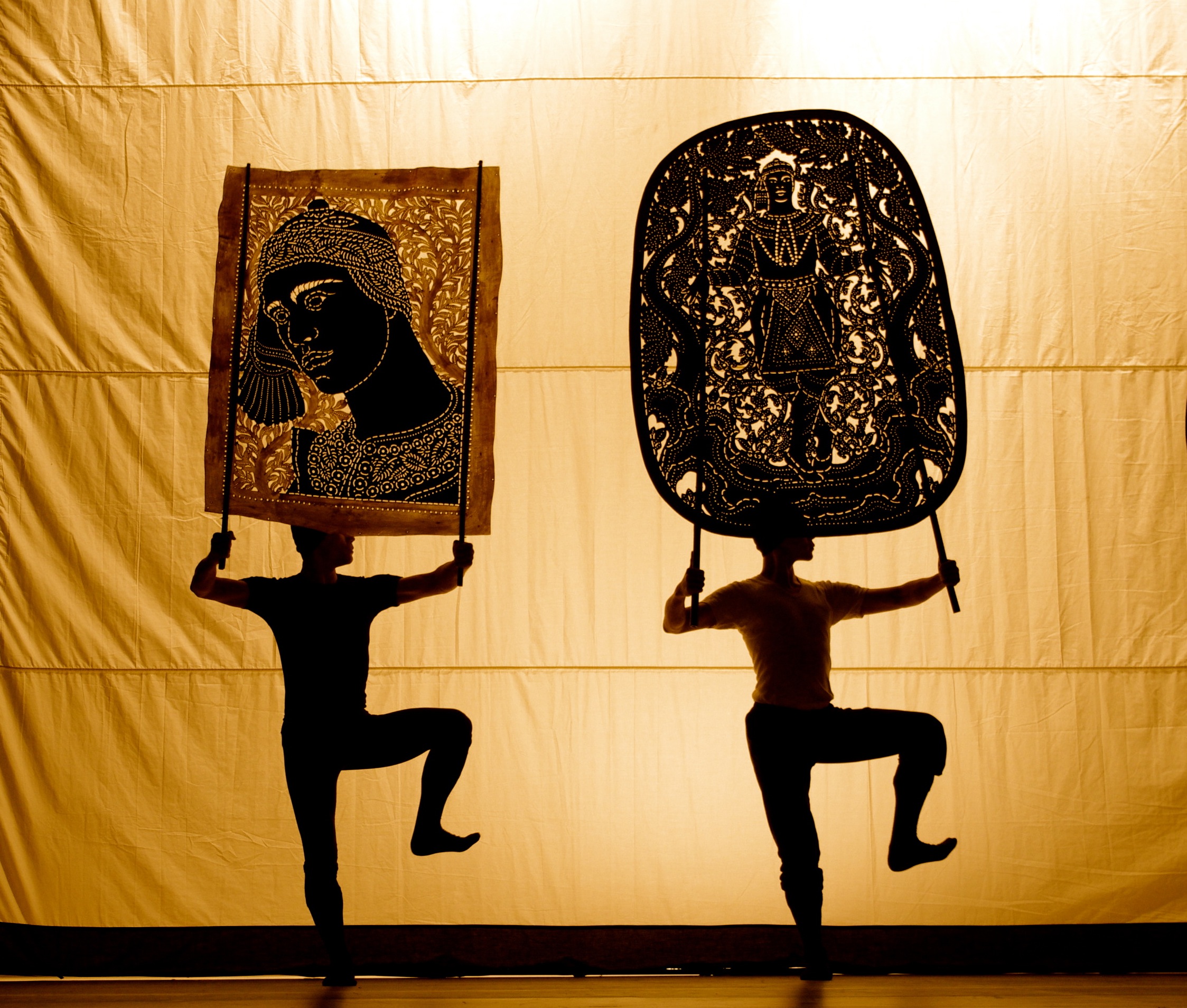
Slow Asian movements with flexed hands, angled legs and dynamic jumps: Not so uncommon for a Thai dancer. But when Pichet Klunchun in his piece „Nijinsky Siam“ perform these, he does not do so in the first place to show his own country´s styles, but to reconstruct the look the famous Ballet-russes-dancer Vaslav Nijinsky had on them 100 years ago. The audience learns that after having heard of a Siamese dance company having performed in Europe, Nijinsky created his famous „Danse Siamoise“, of which nowadays photos are the only thing to remain. With these, which are also projected on stage, Klunchun has not done a pure reconstruction, although it also is historically interesting, but, as he tells his audience via writings on the back wall of the stage, wants to give back a soul to Nijinsky´s famous solo. Inspired by what is to be seen on the photos, he does his own solo in the end of the performance. But he does even more than that. By projecting photos of Nijinsky fading into one another, he makes the Russian dancer kind of dance as well. And he has two other Thai dancers with him, Sunon Wachirawarakarn and Padung Jumpan, who support him to bring to stage what he thinks Nijinsky had been inspired by 100 years ago. So „Nijinsky Siam“ does not try to reconstruct a historical piece, but brings it on one hand back to its origins by having filtered the Siamese dances twice – once by Nijinsky, once now -, and on the other hand creating something new with all respect to the Ballet-russes-creator.
A Mary Wigman Dance Evening by Dean

Dean Damjanovski

The performance “A Mary Wigman Dance Evening” of the young choreographer and dancer Fabian Barba was performed last night on the scene of MSUFA in the frames of the “iDANS” festival. It should also be mentioned that the performance is competing for the award Prix Jardin d’ Europe awarded for emerging choreographers.

What the small audience attending the performance had the opportunity to see were nine solos, which, according to the quite lengthy text that the author gave us prior to the performance, represent a reconstruction of the original solos by Mary Wigman (1886 – 1973), German dancer and choreographer, forerunner of the expressionist dance in Europe. It was obvious that the author has done his “homework” very thoroughly and that he has put much effort to get to the shown result. The reconstructed solos performed by Barba were very clean and precise and one could tell that the other elements of the performance – music, lighting and especially costumes, which were made with taste and sense of authenticity – were paid a lot of attention.

But, this is where the description ends and the problem begins for the performance remained on the level of a demonstration. The performer, quite selfishly, kept us away from the experience of what he was doing on stage by repetitively using the same sequence of “solo – pause with music – solo (with a different costume)”. That is why the first six pieces went without any reaction from the audience even though he bowed after each of them in the manner of Wigman. Maybe that was the response he wanted? Anyway, at the end, when we knew from the program that it was the end, we applauded and called the performer back on stage where he repeated two of the pieces (again, as it was said in the program). Maybe this contract that was made before the performance represented an additional barrier to the communication between the piece and us? Sorry, I almost forgot – there was a tiny and shy applause at the end of the seventh solo, but I’m not sure whether it was because of the effective costume or because of the fact that the dancer finally decided to “put himself” into the performance?

This performance raised a lot of questions for me. For example, whether we as audience should be satisfied with a mere “reconstruction”? And whether the reconstruction itself, understood in this sense, is sufficient or it takes something more to “jump over the edge” and become a performance? For me, personally, last night’s performance remained on the level of a well done homework, but it didn’t manage to transform into a performance…. I wonder how would the “ordinary” audience react without any previous knowledge of Mary Wigman or reconstruction as a method in contemporary performing arts? Perhaps then a real communication would be established? Maybe there is nothing wrong with the performance, maybe we were the problem?

It’s off to work we go

Lise Smith

Bearing in mind perhaps William Morris’s notion that “nothing useless can be truly beautiful”, with E.I.O Maria Baroncea, Eduard Gabia and Dragana Bulut have set out to create something practical and with purpose. Half of the audience become participants in the piece by “working” for an hour using objects on the stage; the workers here control not only the means but the mode of production.

On the stage are rolls of fabric, plastic, string and wire, planks of wood, ladders, tables covered with tools and materials. The workers shuffle in, looking a bit bewildered, and each picks up an object to start “work” with. Participants chalk circles on the floor, build structures out of planks and chairs, wind and unwind string, measure out the surfaces. The watching audience have been asked to choose “the best worker” to pay after the event, so the process of labour demands our attention.

Sometimes the actions of one worker defeat the efforts of another. A tall bespectacled gentleman carefully erases from the floor the chalk circles carefully placed there by a woman ten minutes earlier. One worker builds a rather attractive model animal out of bendy rollers; another deconstructs the model and places the rollers rather more prosaically in her hair. Several workers hang out a string of inflated balloons on a line of string; later somebody else pops them one by one.

As the piece progresses, sculptures form all over the space – a pyramid of planks downstage left, a tent upstage and a towering monument built of chairs and ladders at the back. Every available surface is wrapped in string and plastic. The working environment is transformed by some silently agreed process of collectivebricolage.

Towards the end, it’s apparent that many workers have run out of ideas and some look obviously bored. The pace of work slows and those still active tend to add aimlessly to what already exists –another flower or feather atop structures that were built earlier. The workers lack purpose and the work lacks a defined use – and I think maybe Morris was right about uselessness.

Completing the Circle

Nóra Bükki Gálla

An obvious way for self-definition is to reach back in time and compare ourselves to what we find there. Or better yet, set past and present next to each other and let the comparison be done by the observer. This is exactly what Ecuadorian dancer Fabian Barba does; he takes one of the key figures of modern dance, Mary Wigman, and re-invents her figure with enormous care and historic accuracy, so that we have a precise base for comparison and a good excuse to re-think the present.

Perhaps the most peculiar aspect of the performance is the fact that a woman’s role is danced by a man. The series of solos represent a shift of Wigman’s attitude and compositional values from a strictly formulated and clearly genderless motion language to a more dramatic and emotional quality, but the basis remains the same: for Wigman dance is an act of worship, an ethereal experience which the dancer shares with her audience. This explains the lack of dynamic movement and the domination of expressive hand gestures. Circling motion is a representation of a divine perfection while spinning shows ecstasy.

The 5-7 minute pieces are connected by soft piano music from the background, as if Wigman was dancing on behind the stage and each piece is concluded by an authentic bow taken from films and other documentation Barba used to revive Wigman’s work. The same meticulous care is applied to costumes and music – several times we hear scratchy old recordings which add to the feeling of alienation and detachment.

We are not surprised when the applause brings the dancer on stage again only to repeat two of the etudes. Barba is true to the image he worked out for himself and interprets Wigman with extreme submissiveness. His is an analytical remake, not a constructive one. In Barba’s interpretation Wigman doesn’t want to impress – she simply wants to be. And that is what connects her to contemporary dance and contemporary dancers like Fabian Barba. Even though he lacks the charismatic character and does not feel like the powerful and mature performer we would imagine Wigman to be – still he manages to evoke the past and lets us compare I to the present. And that is the first step n the voyage. A good starting point.

Experiences Limited – All Spoilers, No Criticism

Nóra Bükki Gálla

We met in a 5 star hotel’s bar overlooking the city and were told that shortly we will be taken to a high class residential project to be presented as a group of European investors. We didn’t have much time to invent a story of rich aunts and inherited fortunes. As it turned out, we didn’t need one. But just in case.

Gated communities, we were told, are a big issue in Istanbul because they are in the middle of the city, rich folks throwing their richness into poor people’s faces. Barbed wire fences, bulky security guards, cameras everywhere – such places are possible to access. Unless you want to join the club, of course. Our two facilitators, Anat Eisenberg and Mirko Winkel got an appointment for us for two such projects, dividing the group between two high rise buildings both nearly finished.

We spent the next hour listening to marketing slogans, looking at 3D models and trotting in plastic wrapped shoes upon marble floors of apartments with the price tag of several million dollars, gaped at the Bosporus view from the 66th floor. Having asked all the questions we could come up with, we thanked the salesman, took our minibus and off we went.

So. Was this a performance? Did it have anything to do with dance and choreography? Can such things be called art at all? Whatever the answer, for me personally this was something to take home to remember. Unsettling, liberating, scary, provocative. I keep thinking about the connection of architecture and prestige and wonder whether we all live such gated lives, limited by our own circumstances, preferences and social status. Or is it preconceptions and sheer snobbishness? Mmm. I mean, the gates should be open, shouldn’t they? Or if not, we should at least know that they exist.

But anyway.

Note to the architect: Beware. People want the price tag, not well designed spaces to live in. Now that is something to elaborate on…

The Good, the Bad and the Happiness

Iulia Popovici

Synopsis: a performance about childhood and how “the good” becomes “the bad” as the history turns around. An ironic history:Will You Ever Be Happy Again? had its world premiere in Belgrade, at the BITEF Festival. While working at this performance (in 2008), Sanja Mitrovic became a Dutch citizen, and she had to give up her Serbian nationality.

Once upon a time there was a happy country called Yugoslavia. Really, it was happy, not because even the trees joyfully spelled the name of the leader Tito but because people were happy, even those pictured on the 100 dinars bill. Then the country stopped being happy – until its citizens (fewer now, since the country had become smaller) gathered again on the bridges of the capital, to save it from bombing. Rewind: the Serbian-born dancer/choreographer/director Sanja Mitrovic and the German Jochen Stechmann star a 75 minutes performance (in both Serbian and German) about how the international perception of national identity marks the personal construction of the self, putting in a mirror their own experiences. The Nazi Ahnenpass (certificate of ancestry) of the Stechmann family and little Sanja’s schoolbook from the ‘80s have an equal weight in the subjective spectacle of memory. The result has nothing to do with another semi-digested story about the tragedies of the war in former Yugoslavia, the “German guilt” or the so much commented “Östalgie”. It’s ironic without being bluntly critical; it’s touching without being sentimental – equilibrium very difficult to reach when talking about the innocent bystanders of recent past.

Staging it as a loose children’s game (on the repeating model of “partisans against Germans” – the local form of an otherwise universal patriotic re-enactment of a more or less imaginary glorious history), Sanja Mitrovic rediscovers in Will you ever…the immense theatricality of objects (from photographs and Tito’s statuette, to passports), of ideologically framed movement (as in the performative reconsideration of the choreography of communist mass gatherings), of music as cultural icon (Serbian pop hits). Jochen Stechmann’s merry appearance and Sanja Mitrovic’s self-contained performance make them remember together, in a sort ofcadavre esquis, what they cannot let go of their past as members of a certain community.


Fast-forward: And, of course, famous football matches always become the ideal background for going back to the roots, in a hectic choir of national pride and sense of belonging to a community.

Sanja Mitrovic, Will You Ever Be Happy Again?

Lise Smith

Serbian choreographer Sanja Mitrovic describes duet Will You Ever Be Happy Again? as “a docu-tale for one Serbian, one German performer and two cartoon boxes”. This playful description, indicating both the idea of (problematic) national identity and the materials of theatrical construction neatly sums up Mitrovic’s concept – the exploration of what it means to be Serbian, or German, through the medium of the cardboard box.

The absorbing and provocative performance has performers Mitrovic and Jochen Stechmann narrating – in Serbian and German – their national stories through childhood games and reminiscences. The layered presentation has the two pretending to be children pretending to be “Partisans and Germans”, in a game of cultural stereotypes that reveals early political conditioning: the Serbian word “cockroach”, we are told, translates as “German bug”. Stechmann scuttles bug-like around the floor in illustration; the game, he tells us, does not make him happy.

The layering of playful-unplayfulness continues in the game of “Equal Exchange”, in which Mitrovic and Stechmann comment flatly on the unequalness of exchange after the fall of communism. “I give you something bitter,” says Mitrovic, “and you give me something sweet”. “I’ll give you visas,” counters Stechmann, “and you give me war criminals.” Mitrovic doesn’t want to play any more.

Both performers use artefacts from their upbringing (contained in the cardboard boxes) to narrate both their personal and national stories. Mitrovic shows us the illustrations of war in her Grade 1 schoolbook, describing the scenes matter-of-factly as “the first fire”, “the first bombs”. Stechmann brings out his grandfather’s Ahnenpass, the document which confirms his all-Aryan, non-Jewish identity. Stechmann explains he keeps the document still, because “you never know”.

With simple images, narrated memories and readings from letters, Mitrovic sketches out a complex mesh of hopes, dreams and frustrations. The simplicity is key to the work’s sensitivity – small, personal details allow the audience to grasp the horror of the past and fears for the future far more effectively than a dry exposition of history would. At the heart of this work is a self-determined gesture towards the truth – always inadequate, but always vital.