Skip to content

Posts from the ‘English’ Category

An Essay on Invisibility

Iulia Popovici

(since I’m feeling so guilty for missing today, here you are a text about the Rimini Protokoll performance I saw a week ago; be as critical as you like)

Abdulah (Mr. Dağaçar), Aziz, Mithat and Bayram are experts. They have very precise working hours, they know everything about the object of their activity; they are the best in their field for expertise.

Abdulah, Aziz, Mithat and Bayram are professionals. Experts in trash. Some would call (and are calling) them scavengers. Every day, they cross the Turkish capital with their self-made sort of carriages, in search for recyclable „left-overs“ – paper, cardboards, plastic, aluminum (a nice word for mainly Coca-Cola and Fanta cans). They are the invisible people. Read more

Show me a little bit of your dance

Theresa Steininger

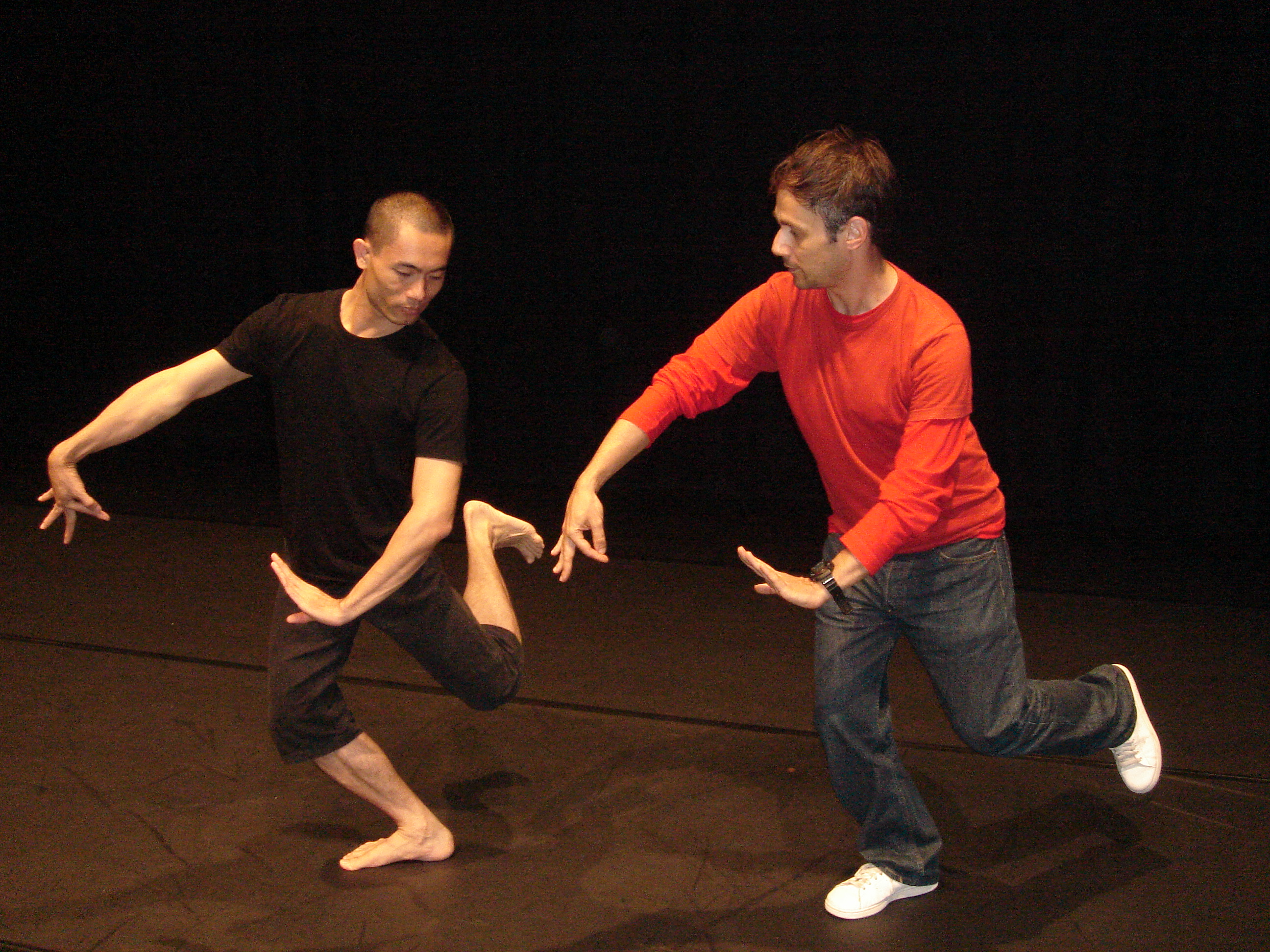
Can you show me a little bit of what your dance is like? This question, posed once by the French choreographer Jerome Bel to the Thai dancer Pichet Klunchun, then vice versa, is the base of the piece “Pichet Klunchun and Myself”  by Bel. The two performers sit on chairs profile to the audience, facing each other, Bel with pen and paper in hand, when asking Klunchun to present first himself and then elements of Khon dance. Klunchun, dressed all in black and barefoot, rises his foot and stamps loudly, presents arm movements, explaining the differences between the port de bras of the four main characters when being asked by Bel. While watching, Bel often frowns, looks and asks naively as a child, sceptically. Together with Bel, the audience learns about how to show grief and death on a Thai stage, walking slowly and drawing tears on the face with the finger. The spectators are shown how to distinguish between prince and princess and how the feeling „relaxed“ is presented through a headmovement forming an eight. Bel asks the questions we would probably pose ourselves. Playfully, Klunchun includes Bel into his presentation when having him being the one to die when Klunchun shoots an arrow in his direction.

After an hour, the vice-versa-version starts. Now it is Klunchun´s turn to question, what are strong elements of Bel´s performances. When Bel shows him as scene in which he does not do more than looking at the audience, Klunchun openly expresses his disappointment. Bel goes on describing that he does not want to represent something on stage, but to show the audience reality. When then showing death on stage in his interpretation, Bel does karaoke with „Kiling me softly“ and finally drops on the floor. To this, he can relate, says Klunchun, when telling about his mother dying softly.

Throughout the piece, Bel and Klunchun also aim to point out the differences in their cultures, finding very little parallels like the role of the king in the development of the dance, but huge opposite opinion as on getting married before having a child. Still, most of the time is dedicated to exploring and trying to understand the other´s style.

on Philipp Gehmacher (2004)

Franz Anton Craemer

(…) The relationship between corporeality, that is concreteness, and conceptuality, that is abstraction, consequently appears more complicated than the milieus of critics, dancers, and choreographers have occasionally wanted to present. Evidently, the spheres of mere reality and of that, which can be said about this reality in terms of dance, are not that clearly divided after all. Of course, whether these categories are at all appropriate to the object – the world, the dance – is another question. Luce Irigaray rejects them in her book “The Way of Love” (2001/2002). She energetically challenges the division of the world in perception and its target, in subject and object, which is customary in philosophical thinking. According to her, this form of philosophy only tends to make everything the same, to assimilate the objective to the subjective, and thus deny all relation of difference.”Our rational tradition has been much concerned with ‘speaking about’ but has reduced ‘speaking with’ to a speaking together about the same things. Which supposes a common universe and conversations about a third without real exchange between ourselves. … But it is not yet then a matter of an exchange between subjects, even if diversity supplies them with an object about which to begin to dialogue.” (p. 7 f.)


Irigary pleads for a new, an other form of language and speech, in order to reach equivalence in a consciously known, acknowledged, and experienced difference.

“For there to be an exchange, it is essential that the other touch us, particularly through words. But we do not yet know this touching with words, except in a mode that reduces proximity to confusion, to fusion.” (p. 18)


And here the long introductory by-pass finally leads to the vicinity of its target area. Namely, however crudely one might paint the cognitive background of the problem: a debate about what the dance could achieve in life and functioning of the society, which potentials it awakens, and which areas it challenges, that is, an examination of the essence of dance, will necessarily deal with such attitudes that take the bodily as their basis; a basis, of course, that can accomplish nothing by itself, but needs a specific form of shaping in order to tell others, to exchange with them, something about itself.


In the light of this, dance could claim the rank of a fundamental practice, it could reclaim validity far beyond logocentrism, it could be an exercise in difference.

“Where has man tried to approach the other through speech without this already being bound in a same that nullifies their differences and produces their exchange to a tautology, an already programmed scenography, a monologue in two voices? … It seems that man in the unfolding of culture, of History, has not ceased moving away from himself.” (p. 46f)


The aim of Irigaray is by no means to cast doubt upon the logical constitution of erkenntnis, of perception in itself. But in her argumentation one might, complementary to this logical form, find the formulation of a way of the kinetic – an invitation to a dance… a dance of turning-towards instead of taking-aback, a dance of individuation.


I have clues for this presupposition. As a matter of fact, the impetus for this text comes from Philipp Gehmacher. In his piece “mountains are mountains” (2003), he quoted some sentences from Luce Irigaray’s “La voie de l’amour” (the original was published in French). Just as decisive was the encounter with Gehmacher’s shaped form of the movement’s aspect, with which and in which a new type of kinetic communication has affirmed itself. Perhaps it is that form of respect for vicinity (of choreographic exchange) and difference (of the basic incompatibility of bodies), that Irigaray denounces and that the constitution of culture, as the common way of being of individuals in their specific contacts, had developed long ago. In any case, as a question of dealing with concrete instead of abstract relations of power, discursivity, or desire, it concerns the foundations of our society.


Thus, this texts aims at accounting for the effect, theimpression that Gehmacher’s choreographic procedure has made upon me. It is to show what kind of offer, what potential is contained in this choreographic material and why I believe that I can draw such far-reaching conclusions from the accentuated difference of Gehmacher’s choreographies to a traditional understanding of dance – although the danger of discursive assimilation, of a failed exchange as a result of such hermeneutic desire, certainly remains high. But this can only be decided at the end of the text and perhaps even much later than that.


I have seen Philipp Gehmacher’s “mountains are mountains” a number of times. My considerations about this choreography for five performers have been shaped in the course of viewing it and reflecting on what I have seen. My confrontation with it therefore took place in several steps – consequently, in a sort of movement. Thus, the first time I saw above all the happenings. I saw the decisions of composition. I saw an enormous choreographic awareness. I could also say: liquefied unshakeability. If I had to find an image for it, I would say: I saw a rather cold mountain creek rush into the valley, broaden over several dam levels into a lake and then flow on, disappearing out of vision. But I had better leave the gravel fields of lyrical circumscriptions and try to reach a firmer ground, that is, to be clearer in concepts and more accurate in description.

I saw “mountains are mountains” for the first time in the Akademietheater of Utrecht, as a part of the Springdance programme of 2003, on 18 April, at 7.00 p.m. Sioned Huws was already waiting as we came into the hall, leaning on the wall. The light stayed on for a long time. The others – one by one, serious, stone-faced – stepped into the corner, joining her. All wore pastel grey clothes. For long periods of time there was stillness; single arms were opening up in small movements. The looks of the five dancers were mostly fixed on the floor, empty, expressionless. To bow the head, to arch the chest, to displace a foot – that was all. But it turned into a great number of moving events. Suddenly, one could notice moments of distress over the dancer’s own self-movement: Gehmacher pressed both hands on his chest, over his heart, and imitated pulsation two or three times. It seemed to be a shock, even in this gazing intensity directed towards oneself, and it was followed by careful listening. Thus it went on for a long time, bordering on standstill. Each stir had an echo, but it was rigid. And mute anyway. Even if many figures, sentences, and phrases were repeated, sometimes stubbornly, mostly casually, one hardly took notice.

They were still stuffed in their corner, all of them. There was a microphone on the back wall. When would they speak? Where was the communication hidden? Instead of giving an answer, Gehmacher fell down heavily. Nobody reacted or took notice. The “covering for the inner being” was not lifted. The five persons were absorbed in an inaccessible world – the unstirrable mountains that, however, did move from the spot after all. Gradually, one could perceive subdued, rhythmical, and also formal approximation, unison, accordance, forwarded as continued pulsation, neural impulses – momentary, intensive, evasive.

In such fine-toned shaping, there appeared, still vague, a sort of negative Neoclassicism, an anti-Laokoon: the four dancers were closely pressed against each other, and in some way they were embraced by the same idea. But they did not break up in expression or screams, in any sort of utterance. They just existed. There was no image of pain, of rapture, or liberation; it was at most being taken aback, glued in a reduced form. Whereas Lessing was searching for a “fertile moment” (the actual core concern of Neoclassicism, in which abstraction and intuition flare up into an idea), Gehmacher’s dynamic immobility seems to be an answer to an inner overpowering, to an unspoken urgency, an existential concern. But the moment of communication is not given as solidification but, so to speak, homoeopathically rarefied into kinetic endlessness. What remains is foreboding and insinuation, not expression.

And then – peace. But this peace is radical, compact. One hears EVERYTHING. One hears life leaking out, just as you would hear breathing next to you by night. You cannot catch up with it. You cannot stop it. But it is also comforting. An experience of closeness. Incorporated in this thematic texture, in this kinetic scrutiny, there are elements of language. From the huge loudspeaker, unusual sounds are coming out, which prove to be an anxious, undertoned Swedish monologue. Later, one can hear distanced calls of human voices and then, first uttered in the microphone, that is, against the wall, and then twisted as a recombined assortment, there come aphoristic observations on closeness and distance relationships.

It is only through the explanations after the performance that the whole conclusiveness of the text choice is demonstrated. In Ingmar Bergmann’s “Persona”, Liv Ullmann plays an actress who has lost her speech and whose sentences are spoken out by another voice – that of her nurse. This shift of the ability of communication – from the actual to the expressed, from the subjective to the transmitted, from the mute to the audible, from one to another – pervades also “mountains are mountains”, a piece about the interactive ability of choreographed (i.e. directed from outside, guided, exposed to gazes) dancers/bodies.

For such work on the establishing moment of dance (which is, after all, only future), Luce Irigaray’s sentences from “The Way of Love” are appropriate (or: obliged). Sioned Huws tells them at first in a pure form, for the microphone and only for it (later, one can hear a sampled collage from the tape). She speaks with her back towards the audience. She actually murmurs rather than speaks. Speaking against the wall, that is, without a direct dialogue partner – given the fact that one of the universalities of language is precisely the alterity, i.e. language is directed TOWARDS THE OTHER – thus implies, in its own representation, primarily an act of negation; it is a performative fall into silence.

Under the sign of such hermeneutic frugality, “mountains are mountains” meets me again in Berlin, at the “Körperstimmen Nr. 8” in Podewil, performance on 5 May 2003, 8.00 p.m. At the beginning, there is NOTHING – disturbing emptiness. But then – a self-dis-covering dramaturgy of interweaving, or better: interwovenness. The slight and slightest movements, their coordination, distress over oneself, they all imply the preoccupation of a specific form – namely, of the dance as kinetic happening – with its former, own, and hypersubjective rules and guidelines. In this way, they reflect a process of argumentation and communication with themselves, as well as with the situation of performance and with those who witness the situation, the spectators (who actually create the situation of performance – thus, it is a double self-communication).

Someone ventures along the wall, away from the others, carefully feeling the way. The five dancers, who formed the original “herd”, distribute themselves throughout the space, some lying, some walking, some twisted and marked by orientating, puzzling eye movements. After a short while, one completely loses the overview. But therefore the trickling articulation becomes clearer and more exposed, the question-answer game, the interlocking, like in an instrumental composition, of movements, gestures, dynamic shifts. The compositional aspect seems perhaps more supple, or at least more clearly outlined and more pressing than at the first seeing. The whole turns into interplay, a process, in which everyone, in every single moment, finds the way to oneself in movement and at the same time pays full attention to the doings of others. Then one of them stands apart, vibrating. The others begin with fast, tapping sequels of steps. Suddenly, one feels some sort of verve. But it can never be entirely distinguished from disruption.

Dance in “mountains are mountains” no longer embodies the wholeness of the self and the body, that is to say, of the self that relinquishes itself in the body. Dance is something that has come into existence as defying the stillstand, even suffocation. And again and again dissolves itself into its particular elements. Swing and dynamics, gesture and pose, they are no longer an expression of a uniform state of (self) perception or controlled shaping of meaning. They are assertions, in the same measure in which they irrevocably develop forms.

In the same way, the hard, paratactic coincidences of eruption and stiffness, of power and inactivity, point to another dramaturgy, to some sort of thematic self-concealment in choreographed exposure. It is precisely this work on dynamic isolation, on unrelated, but subtly coordinated, premeditated, and calculated positions, that creates the vortex effect in this performance. Despite all fragmentariness, it is pervaded by connective dynamics, a “current” – even if one with a great many beds and branches. There is always a utopian moment briefly flashing up (a nugget of gold in the gravelled bed of a current that flows through the plain and over the horizon), insofar as the impossibility of closeness does not necessarily imply total isolation or absolute exclusion from the world. There are others in the same position. In an attempt to liquefy the solid, to move the unstirrable, and to shape this movement into a common expression, an artistic standpoint and a basis for communication – in this act, I see the core of Gehmacher’s dance, in which the resolute attitude of kinetic humanism is formulated.

But the sentences of Luce Irigaray, repeatedly quoted in the piece, retain their validity all the way through. In the rush of the first performance, I noted down the following: “No one can say the whole without risking that communication is made impossible.” In fact, the sentence goes this way: “No one can say the whole without making exchange impossible”. The exchange anyway remains limited and is always endangered; perhaps precisely then, when it takes place in its best, communal sense. That is the topic of “mountains are mountains” and it makes painful sense at the end, when Brynjar Bandlien and Michikatzu Matsune stand there facing each other and touching with their toes and noses. After all that was seen before, it has the value of a real shock. And it is a relief when they part again. For there is too strong a suspicion, even clear evidence, that this closeness has been “forced”.

“How do I deal with the fact that I am not independent, that I am influenced by the doings of other people. … Maybe I am dependent. … A dependence that helps one in life and enables him to connect with the one he is facing”, writes Gehmacher in a note to the piece. To walk along this narrow ridge, from which one can easily fall into tedious repetition or into hollow pathos (of which this text is by no means free); to explore how far one can go with reduction, with the abolition of closeness as human practice, without betraying or at least challenging the human dimension; to find choreographic, i.e. specifically kinetic and communicational answers to Irigaray’s concern with “how to let the other come into presence, even lead them there, without claiming to be their foundation” – that makes brilliant artistic practice: it starts from circumstances, it speaks about the reality, but it transports them through its own, transmitted, self-made, and expected rules into a specificum, a unique specimen, in which itpresents perception. In short, this practice creates a particular space of shaped communication, “a place where the intimate is possible with measure thanks to the respect for the one or for the other”.

The possibility to make bodies so relevant, precisely defined, and intelligible in their appearance, without taking away their original impermeability; thus, the possibility of dance as an attempt to find the way to oneself in the movement, in any moment, and at the same time pay full attention to the doings of others, has perhaps been nowhere so clearly presented as in Philipp Gehmacher’s art of choreography. For it links essentiality, intuition, and shape in a way that neither “betrays” a “substance” for the sake of reality, nor includes the living in a concept. But persists in the concrete moment of respectful encounter with the uncatchable in the ever-changing.

Posted by fac at 10/25/2010 02:48:00 PM 0 comments

Existential Glamour: A German-Côte d’Ivoire performing arts dialogue (2010)

Franz Anton Cramer

For years we have been gotten used to defying various kinds of exoticism in the intercultural performing arts scene. Discourses soar high as to the impossibilities of truly presenting non-Western, extra-European performance in the global arts market without always already chewing up the specificities. Just as capitalism feeds on all that might hitherto have been (or have been considered to be) outside the realm of trade – feelings, atmospheres, habits, patterns – the international festival business transforms Otherness in just another gimmick.Such seems to be the elucidated theatre-goers frame of critical reference (or maybe critical frame of reference?). It insists on the fact that the gaze and the consumption habits of the Western style dominate all those gazes, experiences and dialogues that indeed originate elsewhere, that pursue other kinds of visibility, or that take a specific pleasure of their own. The so called post-colonial state of the art claims that any performance needs to pass or fail the test of Western neo-enlightened appreciation, be it academic or aesthetic. Much of the self-righteousness implicit in these power-driven perspectives does nothing else but to fortify the predominance of criteria issued by the very system that continuously seeks to find somewhere the Good Otherness of performance practices, without ever being able to fully accept them as what they are: incommensurate, superior, more free, self-defined etc. Post-colonial performance critique often seems to be trapped in a neurotic repetition of its own sufferance: Disenchanted with the own representational modes and deficiencies, remote places, performers, traditions, or styles are expected to bring fresh blood and energy. But they are then treated only to subdue their specificities and own-ness. This neurotic perpetuation ends up prolonging and indeed deepening the own discontent. That festival directors and resident artists criss-cross the globe in search for the new, the experiential, the direct, and the unquestioned does not hinder them at all to remain in their own concepts, concerns, and conflicts. The critical criticality of globalised performance-making turns out to be but a symptom of self-indulgence (of which Slavoj Zizek told us the secret: “Love your symptom as you love yourself”).Since approximately five years, a surprisingly un-neurotic and almost triumphant endeavour is developing in a frame that spans German producers, Ivory Coast performers (partly living in France and / or in Germany), a vivid but “hidden” culture of camp clubbing, commercial success, high-culture recognition and “Africa is the Future”-innuendos. A German theatre director (Monika Gintersdorfer of her name), a visual artist (Knut Klassen), a fashion designer (Abdoulaye Koue) are also part of the phenomenon. Meanwhile, the German Goethe-Institute has stepped in, and the prestigious (and stinking rich) German Cultural Foundation has accepted to be a sponsor for the 2010 edition of Abidjan mouvement, a festival spontaneously created in Abidjan last May. The productions will be presented in Berlin’sHaus der Kulturen der Welt and other places of wide recognition.

This project started small, however. Gintersdorfer had come to work with Franck Edmond Yao, a professional dancer from Abidjan who was sent to Paris and there quickly connected to the “Jet Set” group. This was a posh but highly important people with Ivory Coast origins, working in Paris and setting a new style of movement and urban culture, it was soon remarked under the name of “couper décaler”. This in-group culture involved dance moves, clubbing, public relations, live media work, and a big deal of snobism. Theatre director Monika Gintersdorfer, herself rather well established in the official theatre system, invited Yao and some other Ivory Coast performers, and together they tried to find a way of working together. Gotta Depri for instance, an ex-dancer with the highly commercial and exploitative “Afrika! Afrika!” show conceived by Austrian event manager André Heller and touring Europe with immense success, is a trained dancer in African styles. He and Gintersdorfer decided that their common project would be to find out what (European) contemporary dance was all about. Together with changing German actor-translators, Depri and his colleague Yao devised the performance series “Logobi”. In it, the concepts of Côte d’Ivoire dance cultures and the German practices of critical performativity are confronted in a vivid dialogue. So far, there are four editions of “Logobi”, a fifth one is in preparation. The entire series has been invited to the German Dance Platform, a biennial national meeting of outstanding dance work to be held in February 2010.

“Logobi” works simply but efficiently. Depri or Yao explain their vision of dance, the full illustrative, narrative, or traditional intent of any movement gesture, the multiple forms of integrating dance in every day culture. They talk about the virtuosity that is needed to dance, the fight you have to engage with the public so as to keep their attention. (“Everybody knows how to dance in our country. So you have to be really good in order to convince them to look at you!” Yao explains to his partner Laurent Chétouane in “Logobi 3”.) But the greatest mystery, we are told over and over, is the practice of what “white people”, “the Europeans” brought to African countries in a strange mission. “It does not mean a thing”, Gotta Depri claims in “Logobi 01”, performed together with German actor Hauke Heumann, “but they pay a lot of money to do it. So we started to engage in this thing they call ‘contemporary dance’ …”

However, Gintersdorfer insists, this difference made visual has nothing to do with authenticism. “One shouldn’t perceive of the Ivorians as bringing their matierla all ready made. We have had long periods of rehearsal, of trying out, of opening up the formalities contained in Ivorian dance culture so as to find out new systems of presentation. The fact that Franck and Gotta are constantly explaining what they are doing, that they integrate their gestural material in a discursive context has not at all been part of their artistic education.”

The background Depri, Yao and other dancers in the eleven pieces that have been proposed until now (and the seven works being planned for 2010!) bring is a quite conflictual, torn, but at the same time self-determined and glamorous one. Originating from Abidjan and forming part of the Ivorian diaspora in Paris and its suburbs, they make a living of their professional dancing in clubs and “soirées dansantes”, both in Paris and in Abidjan. Yao, who is also a musician and singer, has come to be a star (aka “Gadoukou la Star”). His explosive presence, his frightening self-assuredness, his cool exposure of sexiness, but foremost his brilliant acting and performing capacities make of him one of the lead-players in the Gintersdorfer/Klassen endeavour. This endeavour, without being outspoken or underlined by manifestoes, consists in reshuffling the relation between socially evolved and popularly invested performance practices and the (as I would call it myself) anaemic practice of contemporary dance and its self-reflexive concerns, its aesthetic insignificance and widespread lack of content.

However, even if the Gintersdorfer/Klassen shows seem to do away with all of the pettiness of subsidised formalisms prevalent in the bourgeois and consumerist arts milieu, the initiators present a convincing naiveté. “We never meant to comment on contemporary dance”, claims Gintersdorfer, “personally I didn’t even know what this was all about. My field of knowledge has been drama and theatre. It is only by working with the Ivory Coast people that I discovered all these complicated matters being discussed in the milieu. But really, my approach is theatrical. Had I met priests or truck-drivers, my project would have dealt with religion or car-mechanics.” Indeed, neither “Logobi” nor the more theatrical projects such as “Othello, c’est qui” or “7% Hamlet” come with any kind of missionary impulse. They do not want to convince us either of the deficiency of Western tradition, nor of the supremacy of West-African intensity. The project is basically concerned with a celebration – or let’s call it appreciation – of a specific style of performance with all of its ethnic investment. It celebrates the existential glamour that is a basis for urban adaptations of traditional movement practices. The project aims at presenting, and probably also highlighting the force, the immediacy and the expertise circulating in both the diaspora and the home-context in Abidjan.

The adaptation of Shakespeare dramas in this kind of inter-performative confrontation makes this fruitful clash even more urgent. Both in the Othello and the Hamlet project, the reality of Shakespearean motifs – the Ghost in Hamlet, the jealousy in Othello – in Ivorian contexts is at the core. As in African cultures there is a widespread reality of magic and spell, Shakespeare is read against the backdrop of how to detect “mystical realities” rather than dramatising dramaturgical ideas. How can you dare to threaten a Ghost, asks Yao in “7% Hamlet”, before you have tested his intentions? For there are many types of Ghosts, sorcerers, witches, and demons, all with their own agendas: magicians working for money, féticheurs working for their own good (and to the dismay of others), demons who are just evil and don’t pursue any goal etc. You have to pay attention to small details in order to find out whether you are dealing with a Ghost, and whether you should beware or not. Intermeshed in such demonstrations (including a horrific depiction of a person possessed by an evil spirit) are exchanges on religious beliefs, ethnic identity, serious work and similar big issues. The climax, though, is a dramatic praise by Franck Edmond Yao (always translated by Bernd Moss, his German colleague) of Hamlet’s efficiency to plan and pursue his revenge. He masters his feelings, he fools the world making them believe in his weakness, he leaves the country, he comes back, he makes other people accuse his uncle in his own stead, and, Yao exclaims, “He is so very cool” (“Il est très très fort, Hamlet !”). Hamlet, in this interpretation, is a winner, and thus a role model for combatants in the existential urban environment out of which performance styles emerge.

Likewise, in “Othello, c’est qui”, the question of ethnically mixed couples, Western sexuality and pornographic innuendos, gendered role models and the lack of honour for a black man holding hands with a white woman in public are interspersed in vivid re-enactments of how the jealousy thing was just the work of a demon, and how close would / could be the relations between jealousy, murder, exorcism and fatalism. All of these semi-improvised shows combine multiple translations, the linguistic translation being the most pertinent. For all presentations are in French, translated to German by the non-African colleagues. “What has been a big challenge for the Ivorians was to express themselves in words on issues like politics and religion. This has no tradition there, and it needed a lot of support – also from the part of the German translator-colleagues – to encourage them.”

However, the result of this process is striking as to the fervour and determination with which the social culture depicted in Gintersdorfer/Klaassen’s work is put against political turmoil, social injustice and even civil war. In the recent production “Très très fort” (premiered in full length in October 2009), the history of Ivory Coast, once the haven of wealth and prosperity in West Africa and for almost ten years ravaged by disputes and armed conflicts between different ethnic and economic clans, is presented as an entertainment show. It includes stand-up comedians, impersonations of political actors, accounts of how the young and the beautiful of Abidjan don’t fear the war but only the curfew because then they will be trapped between midnight and 5 a.m. in only one club and cannot show off their fantastic and costly outfits in several locations so as to duly impress their friends. The harsh critique on leading politicians of that time may be shrouded in humoristic clothes, it is extremely outspoken.

What started out to be just an experiment and a personal interest of a small group of people has turned out to be at the core of contemporary debates. Assimilation of HipHop into the high-art context is a tradition in France. But the focus there is on integrating popular culture in the spectacle context dear to a certain milieu; it is an upgrading. What Gintersdorfer/Klassen and their team are aiming at is quite different: It is a mise en abîme of enlightened criticality, starting not from the viewpoint of established aesthetics which might be enhanced, enlarged, complemented, or otherwise altered in status. Rather, it is about defying any kind of patronage or paternalism (some prefer to call it post-colonial complacency) by insisting on the very specificity of one’s own practice. Of course this does not go without the usual mechanisms of Western systems. Capitalism always absorbs otherness so as to make it a value. On the other hand: Why should the artists thus appreciated not take profit? Profit as in obtaining visa, having working permits, health insurance, and good payrolls? To the contrary, it seems to be a particularly sly way of reversing capitalist ways. To integrate the own expertise into a system that is ready to be surprised and feeds on all kinds of expertise makes total sense. But it is not a sense derived. It is a sense of its own – aesthetically calculated, as Gintersdorfer insists over and over again, but still artistically independent, cool, and specific. Just asLogobi, the title of the initial series, is also the name of a popular dance in Abidjan: a dance depicting maximal coolness and toughness of the dancer. It is a caricature of (male) power play. But from this very act of derision it draws its true power: That of staying aloof, alive, and affirmative while subverting the images it produces and the conditions in which they are produced. Decidedly, no neuroticism is involved here. Criticality can finally be at ease.

(published in Obscena # 25, May 2010; partly published in Mouvement, January – March 2010)

Posted by fac at 10/25/2010 02:56:00 PM 

Swansong

Nóra Bükki Gálla


Another one of the experimental pieces presented by the iDans festival, 1:Songs blends sound, image and motion to create a multidimensional vision of what it means to be a woman. German theater maker Nicole Beutler devises a curious on-stage operation in which the feminine psyche is being dissected.

The performer, Sanja Mitrovic, hides behind a line of 5 microphones. In the background black and white photos are projected on a screen: a dark line of people, a woman running and falling to the ground. The images are shown from different angles, dissolving into black shapes and patches then zooming into focus again.

Music is the only companion of the performer in her lonesome voyage of emotions; Gary Shepherd’s pulsing machine-music ranges from soft pop tunes to a monotonous hammering. The performance resembles a concert, lyrics are taken from lines of tragic drama characters like Antigone or Medea. Like in a good concert, there is plenty of space for interaction with the audience (the performer says after the first shocking song: ‘Are you with me?’ or asks someone in the first row to sing with her). Mitrovic plays with her voice like it was an instrument: she screams, hisses, barks and howls as the dynamics of the piece requires.

Beutler uses a minimized movement vocabulary close to everyday gestures, conveying an ironic message: stylized, over-acted dancing between songs or robot-like motions when the performer sings about having a heart.

Like in a concert, the audience is rewarded by an extra song at the end. Thinking back we got the whole classic set of female conflicts of love and hate, desire and repulsion played out in words, gestures and screams, still the question remains whether we learned anything new about what it means to be a woman. Probably not.

Nijinsky revisited

Theresa Steininger

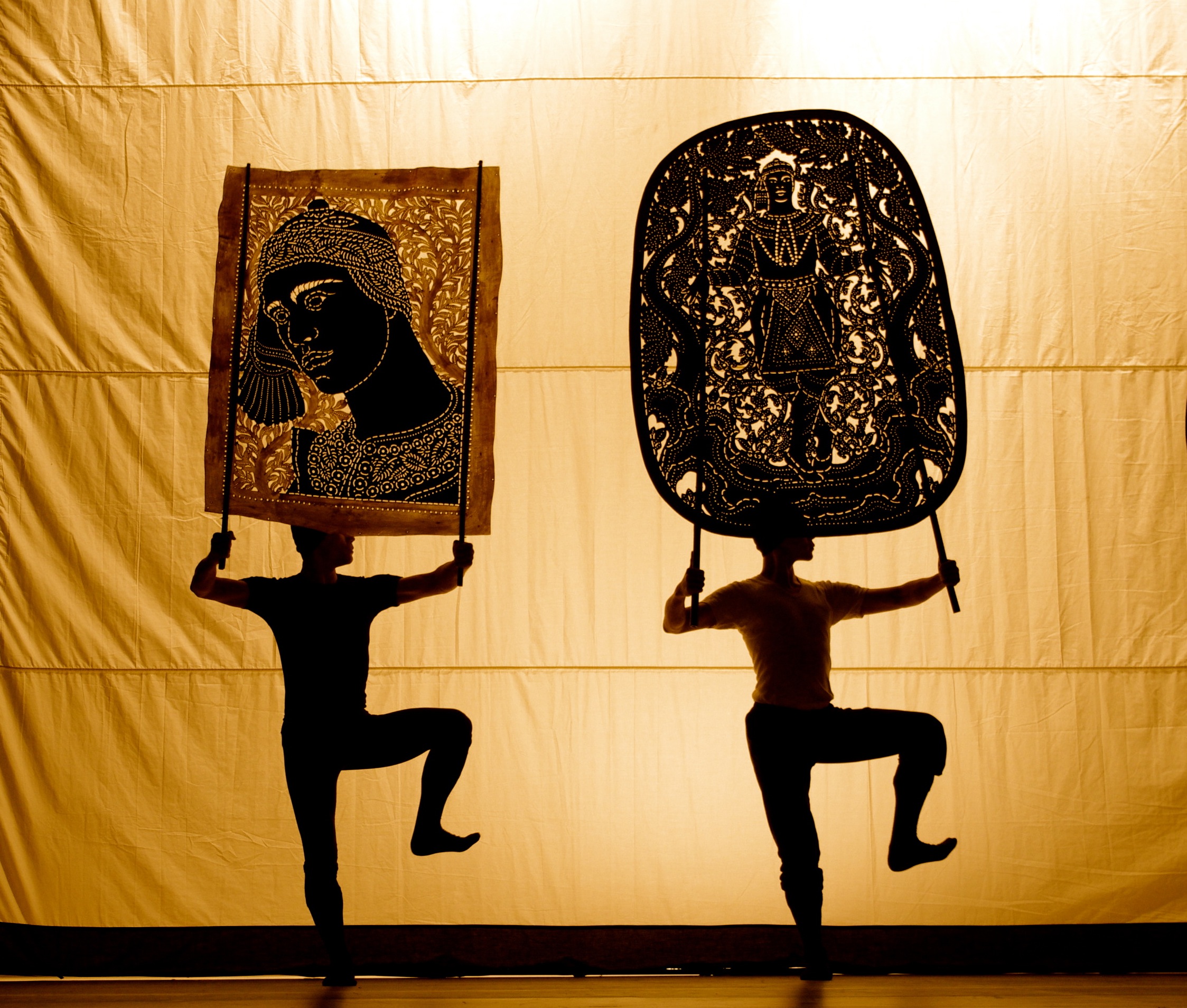
Slow Asian movements with flexed hands, angled legs and dynamic jumps: Not so uncommon for a Thai dancer. But when Pichet Klunchun in his piece „Nijinsky Siam“ perform these, he does not do so in the first place to show his own country´s styles, but to reconstruct the look the famous Ballet-russes-dancer Vaslav Nijinsky had on them 100 years ago. The audience learns that after having heard of a Siamese dance company having performed in Europe, Nijinsky created his famous „Danse Siamoise“, of which nowadays photos are the only thing to remain. With these, which are also projected on stage, Klunchun has not done a pure reconstruction, although it also is historically interesting, but, as he tells his audience via writings on the back wall of the stage, wants to give back a soul to Nijinsky´s famous solo. Inspired by what is to be seen on the photos, he does his own solo in the end of the performance. But he does even more than that. By projecting photos of Nijinsky fading into one another, he makes the Russian dancer kind of dance as well. And he has two other Thai dancers with him, Sunon Wachirawarakarn and Padung Jumpan, who support him to bring to stage what he thinks Nijinsky had been inspired by 100 years ago. So „Nijinsky Siam“ does not try to reconstruct a historical piece, but brings it on one hand back to its origins by having filtered the Siamese dances twice – once by Nijinsky, once now -, and on the other hand creating something new with all respect to the Ballet-russes-creator.

A Mary Wigman Dance Evening by Dean

Dean Damjanovski

The performance “A Mary Wigman Dance Evening” of the young choreographer and dancer Fabian Barba was performed last night on the scene of MSUFA in the frames of the “iDANS” festival. It should also be mentioned that the performance is competing for the award Prix Jardin d’ Europe awarded for emerging choreographers.

What the small audience attending the performance had the opportunity to see were nine solos, which, according to the quite lengthy text that the author gave us prior to the performance, represent a reconstruction of the original solos by Mary Wigman (1886 – 1973), German dancer and choreographer, forerunner of the expressionist dance in Europe. It was obvious that the author has done his “homework” very thoroughly and that he has put much effort to get to the shown result. The reconstructed solos performed by Barba were very clean and precise and one could tell that the other elements of the performance – music, lighting and especially costumes, which were made with taste and sense of authenticity – were paid a lot of attention.

But, this is where the description ends and the problem begins for the performance remained on the level of a demonstration. The performer, quite selfishly, kept us away from the experience of what he was doing on stage by repetitively using the same sequence of “solo – pause with music – solo (with a different costume)”. That is why the first six pieces went without any reaction from the audience even though he bowed after each of them in the manner of Wigman. Maybe that was the response he wanted? Anyway, at the end, when we knew from the program that it was the end, we applauded and called the performer back on stage where he repeated two of the pieces (again, as it was said in the program). Maybe this contract that was made before the performance represented an additional barrier to the communication between the piece and us? Sorry, I almost forgot – there was a tiny and shy applause at the end of the seventh solo, but I’m not sure whether it was because of the effective costume or because of the fact that the dancer finally decided to “put himself” into the performance?

This performance raised a lot of questions for me. For example, whether we as audience should be satisfied with a mere “reconstruction”? And whether the reconstruction itself, understood in this sense, is sufficient or it takes something more to “jump over the edge” and become a performance? For me, personally, last night’s performance remained on the level of a well done homework, but it didn’t manage to transform into a performance…. I wonder how would the “ordinary” audience react without any previous knowledge of Mary Wigman or reconstruction as a method in contemporary performing arts? Perhaps then a real communication would be established? Maybe there is nothing wrong with the performance, maybe we were the problem?