Skip to content

Posts from the ‘Yazarlar / Authors’ Category

Crying out the mutual desparation

Theresa Steininger

Singing, shouting and crying out the mutual desparation of all women, the performer in Nicole Beutler´s „1: Songs“ becomes the personification of famous suffering examples of her sex. In her piece, which Beutler created together with Sanja Mitrovic and Gary Shepherd, Mitrovic is on an almost empty stage, only having five microphones she switches in between. She sings different songs, many of them in some kind psychedelic. The creators have chosen rock music to bring to stage different stories of suffering, like Gretchen´s (of Johann Wolfgang von Goethe´s „Faust“) Marie´s (of Georg Büchner´s „Woyzeck“) or the antique Antigone. Mitrovic cites from Faust, bringing the famous words of Gretchen´s last monologue into a quiet, but agressive rock song. After showing a – in relation to the others – rather simple situation „Please god, let him call me“ with her head in her neck, agression takes over the whole evening, she cries out her wishes, her despariation – „I want everything of life“, but then „If not, I want to die“. This strong situation is cut by a s short „Okay“, she comes to the next scene. Mitrovic barks, pretends to undress, but doesn´t, tells the audience „Watch me vanish“ and in a strong situation moves as if being shot by a machine-gun. She jumps around without any obvious reason, suddenly throws all microphones to the floor, says sorry and comes to a very quiet Shoop-shouwada-song.


Beutler´s/Mitrovic´s performance brings a lot of impressions to stage, some of them very strong, still the red line through the evening was too weak, the topics she had chosen had been presented too often before. Giving the desparation of women a voice, bringing discontend with the world around us to the stage, with the final claim „More than machinery, we need humanity, more than cleverness, we need kindness, we all think too much and feel too little“, which seems important, but also naive after all that came before, the impression remains that of a partly strong performance, but not one that affects – because it is then just one of many.
Life and Strive by Anat Eisenberg & Mirko Winkel

Martina Rösler

The two young artists Anat Eisenberg & Mirko Winkel based in Berlin met each other in the MA-programme „Solo/Dance/Authorship“ at the Inter-University Center for Dance (Berlin). In their new work, created especially for the city of Istanbul, they do a research on the current trends in upper class residential buildings, which are based on the creation of self-contained, separate communities.
A limited number of spectators/participants (maximal 15 people) is meeting on the rooftop of luxury Marmara Hotel, offering a stunning view over Istanbul. The artists introduce their work very briefly and inform us that we are going to have an appointment in such a building pretending we are willing to buy or invest. We are encouraged to create a fake identity in terms of believability.
The duration of the transfer in a minibus stimulates various thoughts about identity, the further development and also doubts about the veritableness of the whole event. Will we ever arrive? We do! The two artists split the group and stay as “assistants” with them. Two different buildings are examined. A “real” sales conversation takes its course, finding ourselves in the 26th floor of the construction site of Rixos Residences with a breathtaking view, talking about prices and furniture. The absurdity of the whole situation, which started playful is getting unpleasant and objectionable. One of the interlocutors is not clearly aware of the fact that the entire dialog is not real, not honest. This unequal degree of knowledgeability makes the project non-transparent and somehow missing the point.
The journey ends again at the starting point, but the “audience” is left alone with a lot of questions. What remains is simultaneously an abiding memory and unique experience as well as an indisposition and discomfort about the whole topic of differentiation, exclusion, affiliation and membership.

Anat Eisenberg & Mirko Winkel, Life and Strive

Lise Smith

In recent years, the definition of choreography has grown far beyond the traditional connotation of “movement set harmoniously to music” to include improvisation, non-theatrical settings, viewer participation and the inclusion into the canon of choreography of works that contain not only little trained dance but little in the way of movement at all.

With Life and Strive Anat Eisenberg & Mirko Winkel push the boundaries of this definition yet further by centring their entire performance around an extended unplanned improvisation by the audience themselves, a participatory “happening” at one of Istanbul’s exclusive new gated communities. The set-up is simple: the small audience group is informed at the beginning of the performance that we are off to a sales meeting with an agent at one of these new residential blocks. We are invited to take on the identity of a genuine prospective buyer, thinking up a suitable backstory for our investment purchase, and off we go to our appointment.

The rare and unfamiliar experience of visiting one of these new blocks, strangely isolated from the world outside and exclusive in every sense, was certainly a new and interesting one – but what of the choreography? A generous reading would probably call this a totally immersive and inclusive performance, generous to its participants in allowing them this elite experience. Another reading would equally probably be, “What choreography?” It’s hard to say exactly what Eisenberg and Winkel actually created, in craft terms at least.

I would have liked there to be some surprise (beyond the initial surprise of being told I was about to attend a sales appointment at an apartment I’m not rich enough to even dream of owning); some further engagement, some reflection on the experience from the artists. An interesting experience, then, but ultimately an empty one.

Nicole Beutler, 1: Songs

Lise Smith

Several recent dance theatre productions have concerned themselves with the physicality of performance in other modes of presentation, particularly live music. One thinks of the surreal puppetry and “sonic haemoglobin” of Pierre Rigal’s Micro, or Gilmore Productions’ touring narrative The Blank Album. As with both of these productions, German choreographer Nicole Beutler’s1: Songs is at one and the same time a performance and a representation of a performance, playing with both the language and the physical codes used by musicians during a live gig.

The piece’s sole performer, Sanja Mitrovic, begins in backlit obscurity, voice echoing into one of the five microphones bristling on the forestage. Mitrovic is severely dressed, in a buttoned-up dark grey shirtdress. Her voice is charmingly fragile, wobbling slightly as she sings the words of legendary female figures ancient and modern: “My bosom aches for him”, “My friends, I can no more”. Comfortable perhaps behind the words of other women, at times the performer seems to accidentally reveal too much of herself; she chants “Please god make him call me back!” long after one track has ended, until she catches herself in the act and coolly calls for the next song.

Gary Shepherd’s music score is in itself entertaining, flitting between indie rock and something that sounds like the bastard progeny of Josh Wink and Joey Beltram – to which Mitrovic pulses through her torso, arms at 3’o’clock, amping to the bass. As the performance progresses, her glacial ice-maiden demeanour and severe dress both gradually unravel; until Mitrovic is skipping around the stage in combat boots, dress unbuttoned and hair flying, screaming the words of Antigone and Medea.

1: Songs is a brave and powerful presentation, and Mitrovic is never less than completely in the moment of performance. A gripping and persuasive look at the female voice through history, through the lens of contemporary concert culture.

Nicole Beutler – Songs

Maxime Fleuriot

Nicole Beutler – Songs

Songs is a solo performance that takes the appearance of a concert led by Sanja Mitrovic. Wearing a very classical and simple dress (« bourgeois » style) the woman looks like rather shy. Yet the outrage and the strenght that show up in the voice, the craziness that show in the eyes and the whole face create an interesting contrast with her appearance. This combination is curious, unique and striking. So are her movements, always surprising, always unexpected. She literally hold the stage with great self confidence. One could think of Claudi Triozzi because of the experiments with the voice but Nicole Beutler’s performance is much darker in what it conveys : suffering, isolation. In fact, it doesn’t look like anything we could have seen before which is the sign of the great performers. However, if the performance starts very well, it loses its powerful charm as it goes on. Unlashing her hair, opening her dress, the performer becomes clearer in her intentions : expressing feminine despair and solitude. The discrepency betwen the appearance and the underlying outrage of the voice tend to disapear. The lyrics of the songs become clearer. Everything become too obvious and one way. Behind the performer, on a screen, since the beginning of the performance, old images are shown. Names of literary heroines appear on these pictures : Ophelia, Antigone, Medea… The images are nice but this will to inscribe this feminine presence in a more general litterary context remain at the level of an intention and seems a little bit forced.

Fabian Barba – A Mary Wigman Dance Evening

Eylül Akıncı

Fabián Barba’s reconstructive work on Mary Wigman, A Mary Wigman Dance Evening, is based on the utmost reassembly of the theatrical elements Mary Wigman used as well as an intention to present her dance in the most faithful way possible, not without accepting that one-to-one staging is impossible and a carbon copy is not even a consideration.

It is not easy for me to asses the original and reconstructed parts of the solos –from three dance cycles, Seraphisches LiedPastoraleSommerlicher Tanz- separately, and probably for any viewer who had not gone through the footage and photo archives; in a way this implies the fact that Barba has succeeded to convey a devoted interpretation and to decipher the intrinsic qualities and aesthetics of Ausdruckstanz in terms of logic, emotion and expressive process. He smoothly constructs a whole work out of the fragmentary material from Wigman’s legacy.

The strange encounter between Barba and Ausdruckstanz, which he himself claims to have had, not necessarily might be valid for the audience, though. In this case, personal history of spectatorship indeed plays an important role; furthermore, certain codes of expressionism –especially German expressionism- is still with us in an internalized and unnoticed way thanks to a myriad of artworks from various disciplines, bearing its undertones on our current experience art and daily life to some extend. After all, changing subjectivities of expressionism is exactly what has not changed after the modernity, and it is not easy to define a big hiatus that would erode memory between modern and post-modern era although most of our presumptions about dance and movement has been transformed on that threshold as much as it had at the beginning of 20thcentury, for this evolutionary history is not an exhaustive one that would create amnesia and, of course, we still have active representatives of these first generation dance forms.

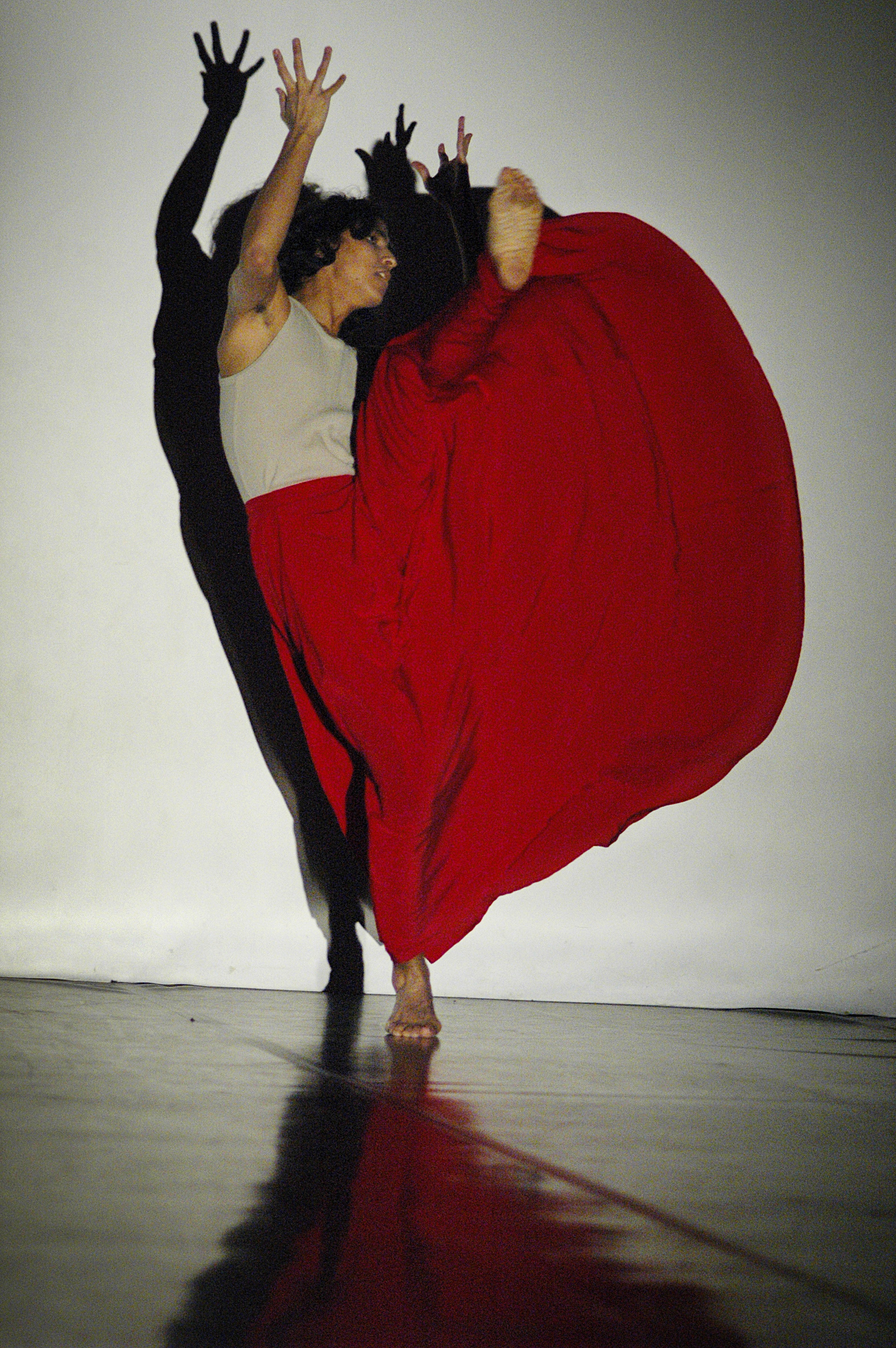
However, watching Barba’s reconstruction is definitely surprising, if not uncanny; sitting face to face with something like a part of your cultural subconscious is enlivening. Mary Wigman becomes alive, gender neutral, breathing loud, in whirling and entrancing costumes (successfully recreated by Sarah-Christine Reuleke), under the music of husky piano and drums, under the chandeliers and behind the red velvet curtain. It feels like a 3D simulation of a 30’s evening indeed, and it creates an excitement in spite of one’s possible familiarity with the expressionist dance by its daintiness on details. The performance as a whole frees the image and movement of Mary Wigman from monochrome and scratchy visuals, thus in a way becomes a live documentary, as much as it is a unique performance, that freshens up our relationship with the past.

“A Mary Wigman Dance Evening”

Dean Damjanovski

The performance “A Mary Wigman Dance Evening” of the young choreographer and dancer Fabio Barba was performed last night on the scene of MSUFA in the frames of the “iDANS” festival. It should also be mentioned that the performance is competing for the award Prix Jardin d’ Europe awarded for emerging choreographers.

What the small audience attending the performance had the opportunity to see were nine solos, which, according to the quite lengthy text that the author gave us prior to the performance, represent a reconstruction of the original solos by Mary Wigman (1886 – 1973), German dancer and choreographer, forerunner of the expressionist dance in Europe. It was obvious that the author has done his “homework” very thoroughly and that he has put much effort to get to the shown result. The reconstructed solos performed by Barba were very clean and precise and one could tell that the other elements of the performance – music, lighting and especially costumes, which were made with taste and sense of authenticity – were paid a lot of attention.

But, this is where the description ends and the problem begins for the performance remained on the level of a demonstration. The performer, quite selfishly, kept us away from the experience of what he was doing on stage by repetitively using the same sequence of “solo – pause with music – solo (with a different costume)”. That is why the first six pieces went without any reaction from the audience even though he bowed after each of them in the manner of Wigman. Maybe that was the response he wanted? Anyway, at the end, when we knew from the program that it was the end, we applauded and called the performer back on stage where he repeated two of the pieces (again, as it was said in the program). Maybe this contract that was made before the performance represented an additional barrier to the communication between the piece and us? Sorry, I almost forgot – there was a tiny and shy applause at the end of the seventh solo, but I’m not sure whether it was because of the effective costume or because of the fact that the dancer finally decided to “put himself” into the performance?

This performance raised a lot of questions for me. For example, whether we as audience should be satisfied with a mere “reconstruction”? And whether the reconstruction itself, understood in this sense, is sufficient or it takes something more to “jump over the edge” and become a performance? For me, personally, last night’s performance remained on the level of a well done homework, but it didn’t manage to transform into a performance…. I wonder how would the “ordinary” audience react without any previous knowledge of Mary Wigman or reconstruction as a method in contemporary performing arts? Perhaps then a real communication would be established? Maybe there is nothing wrong with the performance, maybe we were the problem?